What key concepts are represented in BODS data?
Two things inform the Beneficial Ownership Data Standard (BODS) data model:
what beneficial ownership information is
how it is processed and used
Understanding these concepts and how they show up in BODS datasets will help you interpret or publish high-quality BODS data.
Beneficial ownership is exerted in the real world.
A natural person is a beneficial owner of an entity because of certain interests. These interests may be rooted in legal ownership, or come from controlling the entity, or using its assets. The relationship between the beneficial owner and the entity may be direct, indirect or both. Where it is indirect, intermediary entities, people and their relationships, are part of the beneficial ownership network.
People or entities are obliged in some jurisdictions to disclose their beneficial ownership. They declare this information to a designated agency. Each declaration is a set of claims about the entities, people and relationships within the subject’s beneficial ownership network. Information about those entities, people and relationships is captured by the agency in records which are updated as new claims are made.

Claims about the real world are captured as data.
The highest level object in a BODS dataset is a Statement. Each Statement represents a claim made by a source at a particular point in time. The claim can be about one of three elements of a beneficial ownership network:
an entity (including companies, trusts and legal arrangements)
a person (natural persons who own, control or benefit from entities)
a relationship (consisting of interests between an entity and an interested party)
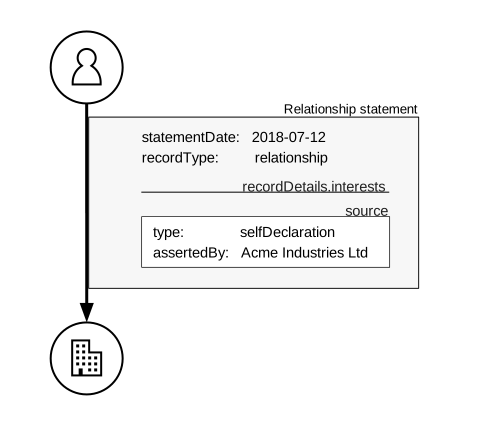
Statements present details about an element of beneficial ownership as claimed at a particular point in time. The diagram above shows a claim about the relationship between a person and an entity.
To achieve this, each Statement produced by a data management system needs to include:
the details claimed about the entity, person or relationship, as stored by records in the system
information about the source, date and context of the claim
After publication, publishers do not edit a Statement to indicate an information update: they publish a new Statement with the updated details of the record.
Data is organised into records.
Data management systems need to internally maintain their own record with an appropriate recordId string for each person, entity and relationship whose details are disclosed. The recordId has two purposes:
linking entities and persons via relationships
publishing information updates
See Record identifiers for full requirements.
Records are connectable.
Stable recordId values in BODS Statements allow the structure of beneficial ownership networks to be derived from BODS datasets.
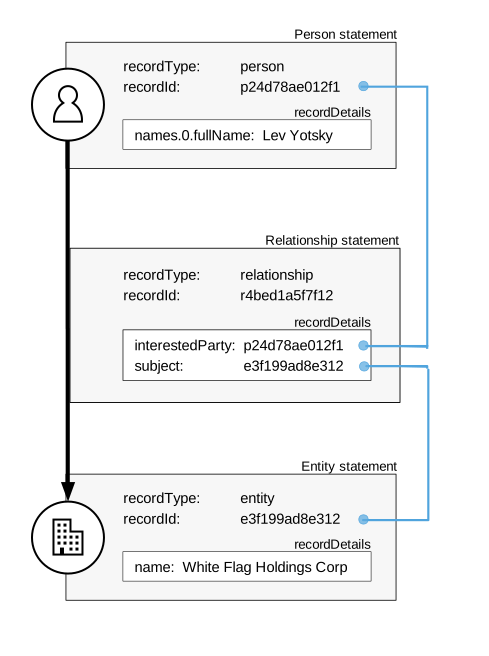
The Relationship statement holds recordId values for the interested party and the subject of a relationship.
Records are updatable.
As real-world beneficial ownership changes, agents submit updated details about people, entities and relationships to the data management system. Then the system updates its records accordingly and publishes a new BODS Statement, containing the relevant recordId, for each updated record.
People can then use recordId values to group Statements made over time to see what information was known when.
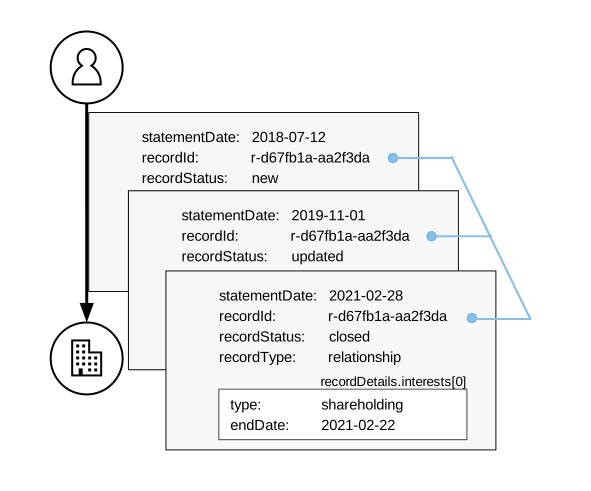
Published BODS Statements build a write-only ledger, as new Statements are issued to amend or confirm details contained in older Statements.
See Information updates for full requirements.
Beneficial owners are visible.
In a BODS dataset, the fact that a natural person is a beneficial owner of an entity is represented by including this information in the Relationship statement linking the two.
It is possible to represent an entity’s declaration that it has no beneficial owners (according to a jurisdiction’s definition of a beneficial owner).
It is also possible to include in BODS datasets information about natural persons who are not beneficial owners. For example, where the managing officials of an entity are disclosed because nobody meets the jurisdiction’s definition of a beneficial owner.
See Representing beneficial owners for full requirements.